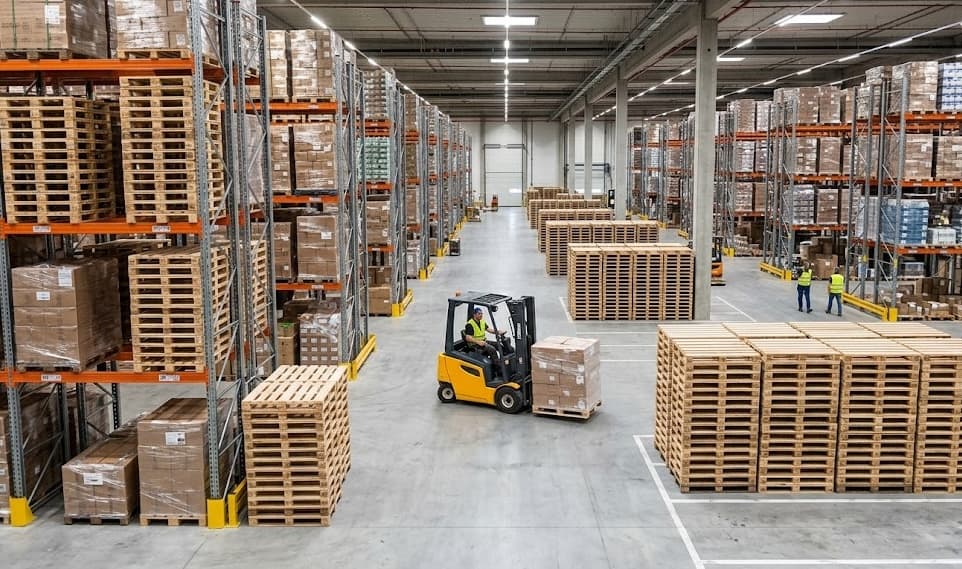
Choosing the wrong pallet is one of the most common — and most costly — mistakes in supply chain management. An undersized pallet leads to product damage and safety hazards. An oversized pallet wastes space and inflates freight costs. The wrong grade means either overspending on appearance that nobody sees, or risking structural failure under load. This guide walks you through the critical factors so you can make the right call every time.
1. Define Your Application
The first and most important question is: what will this pallet do? The answer determines every other specification. Pallets serve fundamentally different roles depending on the application, and each role has different requirements.
Warehousing & Storage
Racking compatibility, consistent dimensions, good static load capacity. Grade B recycled pallets are the standard choice — they offer structural integrity at the best price point for internal operations.
Shipping & Distribution
Dynamic load capacity, durability for repeated handling, four-way entry for versatile forklift access. Consider how many trips the pallet will make — multi-trip applications justify higher-grade pallets.
Export & International
ISPM-15 heat treatment compliance with the IPPC stamp is mandatory. Check destination country requirements — some regions have stricter standards than the baseline ISPM-15 protocol.
Retail & Display
Clean appearance, consistent color, no visible repairs or staining. Grade A recycled or new pallets are appropriate. Some retailers have specific pallet requirements — check with the receiving retailer before shipping.
Food & Pharmaceutical
FDA compliance, heat-treated (not chemically fumigated), no contamination, stored in clean conditions. Traceability documentation may be required under FSMA regulations.
One-Way / Expendable
The pallet will not be returned. Grade C recycled pallets or economy-grade options provide the lowest per-unit cost. Structural integrity for a single trip is the only requirement.
2. Get the Size Right
Pallet size affects everything downstream: how efficiently you use trailer space, how many units fit in a rack bay, and whether your product overhangs the edge (which creates damage risk and safety concerns). The goal is to match the pallet footprint to your product dimensions as closely as possible.
The 48x40 inch GMA pallet is the most common size in North America for good reason — it fits standard rack bays, optimizes 53-foot trailer floor space (two pallets wide, with room for 20-24 per trailer), and is the most readily available and affordable option on the market.
However, some products and industries benefit from different sizes. Drums and barrels often perform better on 48x48 pallets. The telecom and paint industries frequently use 42x42 pallets. International shipments to Europe may require 800x1200mm Euro pallets (EUR1 standard) to match the receiving facility's infrastructure.
Pro Tip: Avoid Product Overhang
Products extending beyond the pallet edge are vulnerable to damage during handling and transit. They also create an unstable load that is more likely to shift or topple. If your product dimensions require overhang, consider moving to the next standard pallet size up, or ordering a custom-sized pallet that matches your product footprint exactly.
3. Understand Weight Capacity
Every pallet has three distinct weight capacities, and confusing them is one of the most dangerous mistakes in pallet selection:
Dynamic Load Capacity
~2,500 lbs for standard GMAThe maximum weight a pallet can support while being moved by a forklift or pallet jack. This is typically the lowest of the three ratings because the load is unevenly supported during movement.
Static Load Capacity
~2,800 lbs for standard GMAThe maximum weight supported when the pallet is sitting stationary on a flat, solid surface with the load evenly distributed. Higher than dynamic because the full bottom deck supports the load.
Racking Load Capacity
~2,000 lbs for standard GMAThe maximum weight when the pallet is supported only at its edges on rack beams. This is the most demanding loading scenario because the center of the pallet spans unsupported. Exceeding this rating risks catastrophic deck board failure.
Always select pallets based on the most demanding loading condition in your operation. If your pallets will be placed in racking at any point, the racking load capacity is your limiting factor — not the static or dynamic rating. Adding a 15-20% safety margin to your calculated load is a sound engineering practice.
4. Choose Your Material
While wood pallets dominate the market — accounting for over 90% of all pallets in circulation — it is worth understanding the alternatives to confirm that wood is the right choice for your application (in most cases, it is).
Softwood (Pine, Spruce)
Hardwood (Oak, Maple)
Plastic
Presswood / Composite
For the vast majority of supply chain applications, softwood recycled pallets offer the best balance of cost, performance, availability, and sustainability. Hardwood pallets are justified for heavy industrial loads. Plastic and composite pallets serve niche applications where their higher cost is offset by specific performance requirements.
5. Making the Final Decision
With your application, size, weight, and material requirements defined, the final decision comes down to matching these specifications with the right grade and supplier. Here is a quick decision framework: