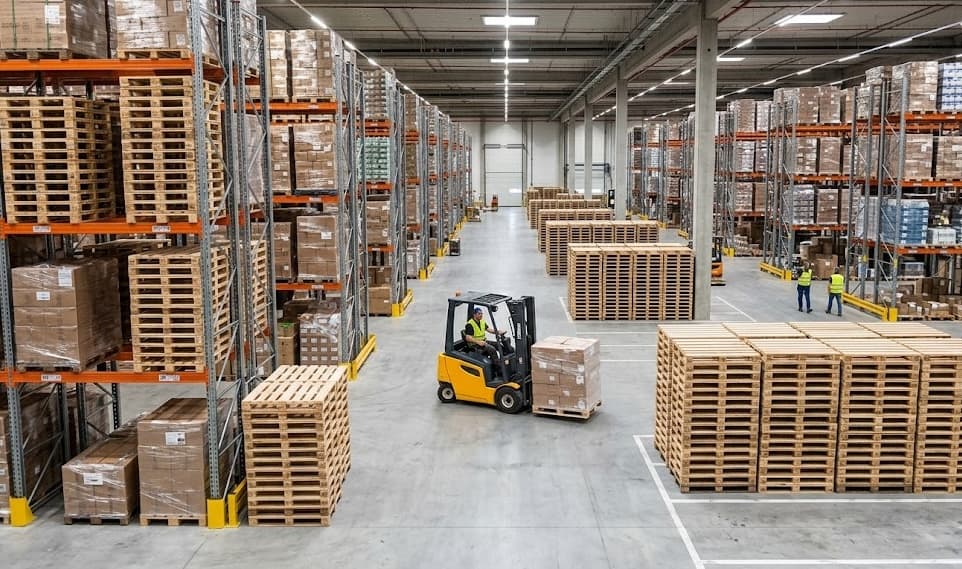
If your business receives shipments on wood pallets, you have a pallet disposal problem. Incoming pallets accumulate quickly — a busy receiving dock can generate dozens or even hundreds of empty pallets per week — and without a plan, those pallets become a space-consuming, fire-hazard liability stacked against your back wall. The easiest option is to call a waste hauler and send them to the landfill. It is also the worst option by every measure: cost, environmental impact, and missed opportunity.
The reality is that used wood pallets have value. They can be recycled, repaired and resold, repurposed into new products, donated, converted to mulch, or used as biomass fuel. Every one of these alternatives is better than landfill disposal — better for your bottom line, better for the environment, and often better for your local community. Here is a complete guide to your options.
Recycling Programs: The Most Common and Practical Option
Pallet recycling is the backbone of the used pallet industry. Companies like Phoenix Pallet Recycling collect used pallets from businesses, sort them by size and condition, repair those that need it, and sell them back into the supply chain for reuse. This is the most scalable and economically efficient disposal alternative because it creates a closed-loop system where pallets cycle continuously between users rather than flowing from manufacturer to landfill.
Most pallet recyclers will pick up your used pallets at no charge — and many will actually pay you for them. The payment depends on the size, condition, and quantity of the pallets. Standard 48x40 pallets in repairable condition typically command $1 to $4 each, depending on market conditions. Even damaged pallets that cannot be repaired have value as a source of repair lumber and raw material for grinding.
Setting up a recycling program is straightforward. Designate a staging area near your receiving dock where empty pallets can be stacked neatly. Contact a local pallet recycler to establish a regular pickup schedule — weekly, biweekly, or on-call depending on your volume. Sort pallets by size when possible, as mixed-size loads take longer to process and may reduce your per-pallet payment. Phoenix Pallet Recycling offers free pickup service throughout the Phoenix metropolitan area with flexible scheduling to fit your operation.
Sell Your Surplus: Turn Waste Into Revenue
If you generate a consistent volume of good-quality used pallets, selling them directly can be more profitable than simply having a recycler pick them up. The used pallet market is active in the Phoenix area, with demand from smaller businesses, farmers, landscapers, and DIY buyers who cannot afford or do not need new pallets.
The key to maximizing your revenue is consistency and presentation. A business that can guarantee 200 clean, sorted, standard-size pallets every two weeks will always get better pricing than one offering a random assortment of mixed sizes and conditions on an unpredictable schedule. If you are not sure what your pallets are worth, contact Phoenix Pallet Recycling for a free assessment — we will inspect your inventory and provide a fair per-pallet price based on current market conditions.
Upcycling Ideas: Creative Second Lives for Pallet Wood
The pallet upcycling movement has grown from a niche DIY hobby into a legitimate secondary market. Pallet wood — especially hardwood species like oak and maple — is prized for its weathered aesthetic, visible grain, and rustic character. Common upcycling projects include garden planters, vertical herb gardens, outdoor furniture, wine racks, bookshelves, picture frames, accent walls, headboards, coffee tables, and chicken coops.
For businesses, offering free or low-cost pallets to local makers, community gardens, schools, and nonprofit organizations is excellent public relations. Post your available pallets on community boards, social media marketplace groups, or contact local makerspaces and woodworking clubs. Many will gladly pick up the pallets themselves, saving you the hauling cost.
Safety is critical for upcycling. Only pallets stamped with "HT" (heat treated) should be used for projects involving human contact or food growing. Avoid pallets marked with "MB" (methyl bromide fumigation) and any pallets with visible chemical stains, oil contamination, or unknown treatment history. When in doubt, use new or certified heat-treated pallet wood from a trusted source.
Donation: Community Benefit and Tax Deductions
Donating used pallets to nonprofit organizations, community gardens, Habitat for Humanity chapters, schools, and churches is a disposal option that creates genuine community benefit. Many organizations use pallets for raised garden beds, temporary fencing, event staging, storage platforms, and building projects. Animal rescue organizations use pallet wood to build shelters, kennels, and fencing.
Donated pallets may qualify as a tax-deductible charitable contribution if donated to a registered 501(c)(3) organization. The deductible value is the fair market value of the pallets at the time of donation — typically $2 to $5 per pallet for standard sizes in usable condition. While the individual tax benefit is modest, it adds up for businesses donating hundreds of pallets per year and provides a meaningful contribution to community organizations that operate on tight budgets.
Mulching: Ground Wood for Landscaping
Pallets that are too damaged for repair or resale can be ground into landscape mulch using industrial wood grinders. The resulting material is screened for size consistency and cleaned of metal fasteners before being sold for residential and commercial landscaping, playground surfacing, and erosion control applications.
In the Phoenix area, where desert landscaping relies heavily on ground cover materials to retain soil moisture and suppress weeds, recycled pallet mulch is a popular and affordable product. A single pallet produces approximately 25 to 35 pounds of mulch material, depending on the pallet's size and wood density. For pallet recyclers, mulch production provides a revenue stream from material that would otherwise have no value — ensuring that even the most damaged pallet stays out of the landfill.
Biomass Fuel: Energy Recovery From End-of-Life Wood
The last productive use for pallet wood before disposal is biomass energy conversion. Wood that cannot be used for any other purpose — heavily contaminated, painted, or chemically treated wood — can be processed into biomass fuel chips and burned in industrial boilers and biomass power plants to generate electricity and steam. This energy recovery ensures that even the lowest-grade pallet material contributes something useful before reaching the end of its lifecycle.
Biomass energy from pallet wood is classified as renewable because the carbon released during combustion was recently absorbed from the atmosphere by the growing tree, as opposed to fossil carbon that has been sequestered underground for millions of years. While biomass combustion does produce emissions, it is far preferable to landfilling the same wood, which generates methane — a greenhouse gas approximately 80 times more potent than CO2 over a 20-year period.
Why Landfill Is Always the Worst Option
Sending pallets to a landfill costs you money (disposal fees), wastes a valuable material (lumber), generates greenhouse gases (methane from anaerobic decomposition), and occupies limited landfill space that could be reserved for materials that truly have no alternative disposal pathway. Wood pallets account for approximately 8% of all wood waste in U.S. landfills — a staggering volume considering that nearly 100% of pallet wood can be recycled, repurposed, or converted to energy.
Some municipalities have begun restricting or banning wood pallet disposal in landfills, recognizing both the environmental impact and the opportunity cost of burying a recyclable material. Even where landfill disposal is still permitted, the tipping fees for wood waste continue to rise as landfill capacity tightens. Businesses that establish recycling relationships now will be ahead of the curve as regulations and economics increasingly favor diversion over disposal.